What Does a Needs Assessment Consultant Do?
Foundations, nonprofits, government programs and other mission-driven agencies work hard to serve their communities effectively. But how do you know if your programs are addressing the right issues? How do you identify gaps in services or understand what your community truly needs? That’s where needs assessment comes in—a needs assessment consulting team can help organizations make informed, data-driven decisions about where to focus their efforts and resources.
At its heart, the needs assessment process involves discovery. It helps organizations understand the gap between what currently exists and what should exist to better serve their community. A needs assessment consultant brings expertise, objectivity, and systematic methods to uncover these insights so that programs and services can be designed or improved with confidence. In this post, we’ll explore the value of needs assessment, explain what the process looks like, and offer tips on how to work with a needs assessment consultant.
Why is Needs Assessment Beneficial for Mission-Driven Organizations?
For organizations committed to serving their communities, good intentions aren’t enough—you need to know that your efforts are making a real difference. Needs assessment is the systematic process of identifying and analyzing the needs of a community, organization, or target population. It provides the evidence base for designing new programs, improving existing services, or making strategic decisions about resource allocation. A needs assessment consultant brings research expertise, analytical skills, and an outside perspective to help organizations gather the right data and draw meaningful conclusions.
Whether you’re a community health center trying to reduce barriers to care, a workforce development nonprofit designing training programs, or a government agency allocating limited funds across multiple priorities, needs assessment provides the foundation for decisions that matter. A needs assessment consultant brings research expertise, analytical skills, and an outside perspective to help you gather the right data, hear from the right voices, and draw meaningful conclusions that align with your mission. For mission-driven organizations operating with constrained resources and high accountability standards, needs assessment is essential for ensuring every dollar, every program hour, and every staff member’s effort goes toward creating the change your community deserves.
Here are three key reasons why needs assessment is vital and how a consultant supports the process:
1) Understanding Your Community’s True Needs
It can be difficult to make effective program decisions based on anecdotal evidence and limited information. While firsthand experience is valuable, it doesn’t always reveal the full picture. Further, community needs continue to evolve over time the information that an organization started with might not fully represent the current landscape. Needs assessment consultants help organizations take a systematic approach to understanding community needs, barriers, and assets.
Through key stakeholder interviews, surveys, focus groups, community forums, and data analysis, consultants gather diverse perspectives and identify patterns that might not be immediately obvious. This comprehensive understanding ensures that programs and services are truly responsive to current community needs.
A thorough needs assessment builds credibility with funders, partners, and the community itself by demonstrating that decisions are grounded in evidence.
2) Identifying Gaps and Prioritizing Resources
Needs assessment consultants help organizations identify where services and resources are lacking, where duplication exists, and where resources could be better allocated. By reviewing existing data sources and analyzing standardized indicators, consultants reveal gaps that require attention and opportunities for collaboration with other organizations.
In this part of the process, consultants also help organizations prioritize which needs to address first based on factors like severity, feasibility, and alignment with mission. Their objective perspective helps organizations make tough decisions about where to focus limited resources for maximum impact.
3) Building a Foundation for Program Design and Improvement
Needs assessment consultants help organizations use data and community input to inform program design, refinement, or expansion. Whether you’re launching a new initiative, adapting an existing program, seeking funding, or navigating regulatory transitions, a well-conducted needs assessment provides the justification and direction needed to move forward strategically.
A strong needs assessment includes recommendations that are specific, actionable, and tied directly to the data collected. This ensures that organizations have a clear path forward grounded in community voice and evidence.
What Does the Needs Assessment Process Include?
While specific details of the needs assessment process will vary by organizational or program needs, below are five core elements of the process.
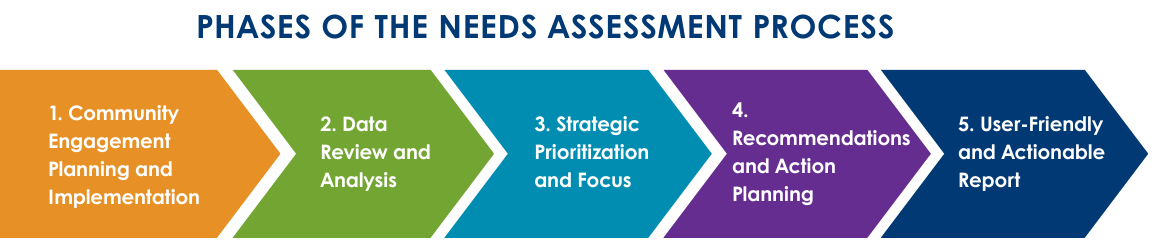
1. Community Engagement Planning and Implementation
Needs assessment consultants work with organizations to develop comprehensive community engagement plans that forge meaningful connections with local leaders and stakeholders. This involves:
- Conducting key stakeholder interviews
- Designing and disseminating surveys
- Hosting community forums and listening sessions
- Arranging and facilitating focus groups
During this phase, in addition to analyzing the data gathered from direct community engagement consultants ensure that the needs assessment captures authentic voices from diverse community members and reflects the perspectives of those most affected by the issues being studied.
2. Data Review and Analysis
To ensure that findings are accurate and comprehensive, in addition to analyzing the data gathered from direct community engagement, consultants review existing data sources, including internal program data and publicly available databases. This can involve trend analysis with existing data, identification of standardized health or community indicators, and GIS mapping for visualizing service areas and needs. A strong needs assessment process uses both quantitative and qualitative data to paint a complete picture.
3. Strategic Prioritization and Focus
The most successful needs assessments help organizations focus their efforts strategically. The needs assessment process helps organizations:
- Identify patterns and themes across data sources
- Compare findings to best practices or benchmarks
- Understand both the nature and magnitude of needs
- Prioritize community needs that align with program scope and capacity
4. Recommendations and Action Planning
A comprehensive needs assessment process provides clear direction by:
- Prioritizing needs based on urgency and feasibility
- Offering specific, evidence-based recommendations
- Identifying potential partners or resources
- Outlining next steps for implementation
5. User-Friendly and Actionable Needs Assessment Report
All elements of the process are brought together and formalized in the needs assessment report. This document should be written in a way that is accessible, compelling, and actionable. These reports often include the following:
- Executive summary of key findings
- Detailed description of methodology and data sources
- Clear presentation of needs and gaps identified
- Specific recommendations tied to evidence
- Appendices with supporting data and materials
These reports may be further supplemented with presentations or learning summits that help you report findings back to your community.
How to Work with a Needs Assessment Consultant
At EVALCORP, we’ve supported a wide range of organizations through needs assessment. We understand that every community is different and tailor the assessment process to reflect each group’s unique context, culture, and priorities. Based on our experience, here are three ways to get the most out of working with a needs assessment consultant:
1) Be Clear About Your Purpose and Audience
Every needs assessment begins with clarity about why you’re conducting it and who will use the results. Are you seeking funding? Designing a new program? Making decisions about service expansion? Responding to regulatory requirements? The more specific you are about your purpose and intended audience, the more focused and useful your needs assessment will be.
Your consultant can help refine your questions and approach, but understanding your “why” from the start is essential.
2) Engage the People Most Affected
Needs assessment works best when it includes the authentic voices of those who will be impacted by any decisions made. Community members, program participants, frontline staff, and other stakeholders all bring critical insight to the table. Consultants design engagement processes that make it easy and meaningful for people to share their experiences and perspectives through interviews, surveys, focus groups, and community forums.
This inclusive approach both improves the quality of the findings and builds trust and buy-in, which is critical when it’s time to act on the recommendations.
3) Be Prepared to Act on What You Learn
A needs assessment is only as valuable as the action it inspires. That’s why it’s important to think about implementation even before the assessment begins. A good consultant helps you create recommendations that are realistic and achievable, given your capacity and resources.

Organizations that commit to using their needs assessment findings to drive change are better positioned to secure funding, build partnerships, and make a lasting difference in their communities.
Building Stronger Programs Through Needs Assessment
Working with a needs assessment consultant is an investment in your organization’s effectiveness and impact. By understanding your community’s true needs, identifying service gaps, and grounding decisions in data, the needs assessment process can help you serve with greater intention and make a deeper difference.
Whether your organization is required to conduct a needs assessment, looking to expand services strategically, or simply wanting to ensure you’re addressing the most pressing issues, needs assessment offers a path forward. With the right consultant by your side, the process can be both illuminating and empowering.
If you have further questions about how EVALCORP might help you with your needs assessment process, we would love to connect. Schedule a consultation with us to learn more!
Read our latest…
- The BHSA Transition Guide Part 7: Understanding DHCS’s Theories of Change for Statewide Behavioral Health Goals
- A Proven Partner for BSCC Grants
- Evaluation Methods Quarterly: Synthesizing an Evaluative Judgment
- From CHA to CHIP: Your Roadmap to PHAB Readiness
- Is Your Nonprofit Ready to Grow? Five Questions to Ask for Successful Capacity-Building