A Decade of Data-Driven Progress: Ventura County’s Public Safety Realignment Efforts
When California’s Public Safety Realignment Act (AB 109) shifted responsibility of custody and supervision for certain offenders from the state to local counties, counties faced a significant challenge: how do you measure success when implementing a major policy shift? Ventura County’s Community Corrections Partnership (CCP) answered this question by investing early in evaluation capacity—and the results speak for themselves.
For over a decade, EVALCORP has partnered with Ventura County’s Probation Agency to evaluate and support the county’s realignment efforts. What began as a foundational assessment has evolved into a comprehensive, ongoing evaluation system that tracks outcomes, informs policy, and demonstrates the power of evidence-based decision-making in criminal justice.
Building a Foundation for Success Through Justice System Assessment
The journey started with the basics. In 2014, EVALCORP conducted a foundational assessment that inventoried available data and mapped partner engagement across the system. This critical first step established a baseline understanding of what information existed and, just as importantly, identified where additional evaluation capacity was needed.
From there, the work evolved logically and strategically. Early evaluations surveyed Deputy Probation Officers (DPOs) and interviewed CCP members to understand the operational impacts of realignment. By 2016, the infrastructure was strong enough to begin tracking recidivism outcomes for AB 109 clients who received supervision by probation. Jail and probation data was strategically incorporated into comprehensive recidivism analyses.
This phased approach demonstrates an important principle in evaluation: you can’t measure what matters until you understand what data you have and build the systems to track it reliably. Each year built upon the last, moving from descriptive snapshots to relational analyses that could connect supervision and treatment engagement with outcomes and recidivism.
Ventura County’s willingness to invest in this foundational work has paid dividends, enabling increasingly sophisticated analyses that inform real-world decision-making.
The Power of Partnership and Data Integration
One of the most significant and valuable achievements of this ongoing evaluation work has been the integration of data across partners. By integrating Probation Agency and Sheriff’s Office data, EVALCORP was able to more comprehensively understand all AB 109 individuals. Assessments consider longstanding criminal history in the county and integrate those who are and are not served by probation. As new questions and needs emerged, EVALCORP was able to integrate new data, such as state-level realignment metrics or program-specific outcomes.
This integrated approach to data provided a comprehensive picture of realignment’s impact. Strong collaborative partnerships were cultivated through consistent engagement, shared goals, and the recognition that good data serves everyone’s interests.
One Decade In: What the Evidence Revealed
After a decade of evaluation, clear patterns have emerged.
Promising Decline in Recidivism Rates
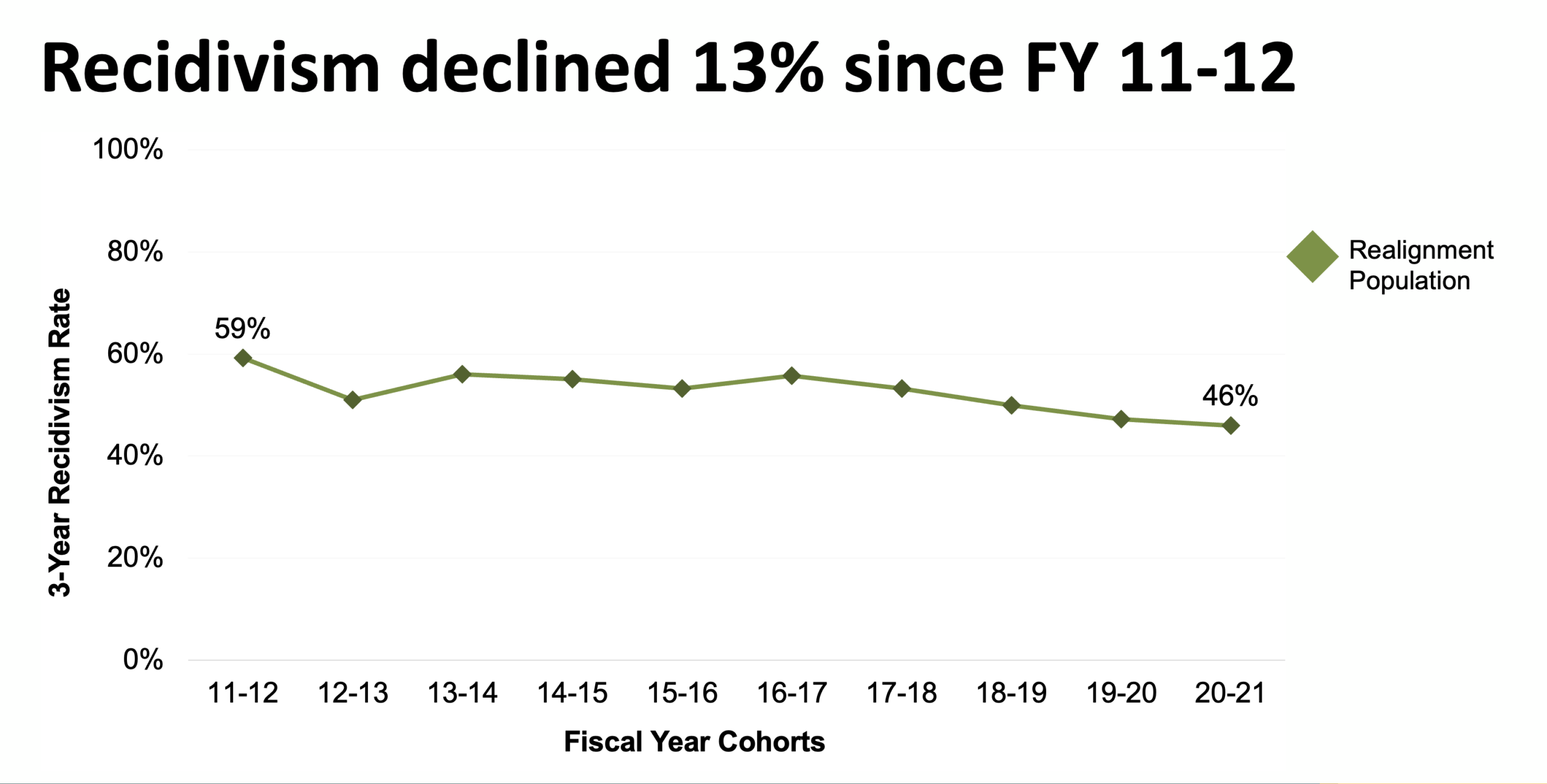
The most encouraging finding: three-year recidivism rates declined 13% since the beginning of realignment, falling from 59% to 46%. While rates varied slightly from year to year, the overall downward trend is unmistakable and holds across all types of AB 109 individuals.
Recidivism Trends: Timing and Offense
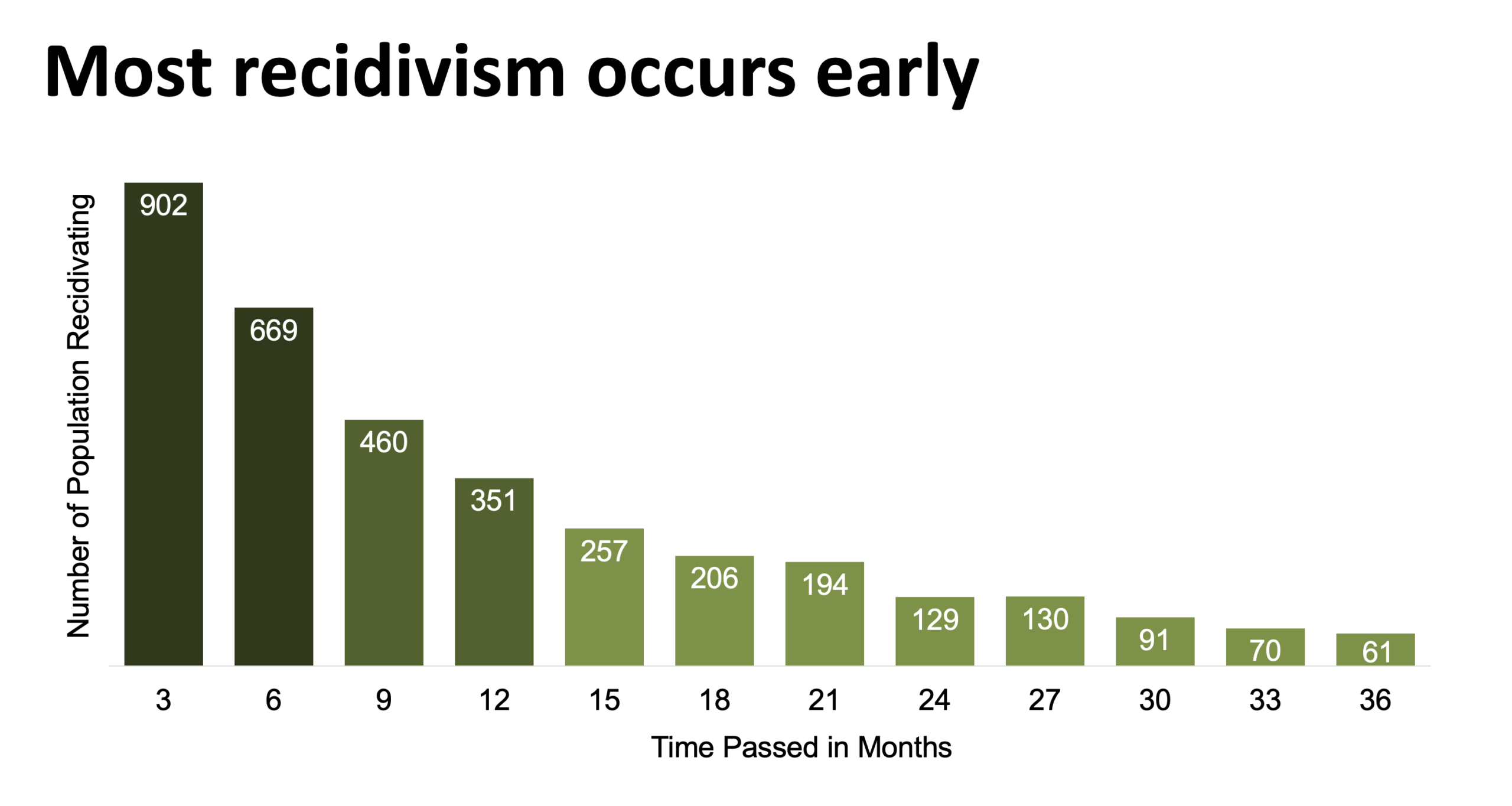
The data also revealed critical insights about timing and risk. Among those who recidivated, 44% committed their first new offense within six months of release, and 68% did so within one year. This pattern highlights that the period immediately following release represents the most critical window for intervention—when timely engagement and coordinated service delivery can make the greatest difference.
Analysis of recidivating offenses shows that misdemeanor crimes against society constitute the largest share of new convictions, with over half of these being drug and narcotic offenses. This finding points toward specific areas where prevention and treatment efforts might be most effectively targeted.
Probation Services Engagement
Survey data helped provide insights into client engagement levels in ARRC services. Clients engaged most heavily in Moral Reconation Therapy (MRT), Thinking for a Change (T4C), and Job Readiness/Employment Services, with Education Services seeing the least engagement. The majority of clients reported that ARRC services were helpful.
Case manager relationships stood out as a consistent strength. Between 67–85% of respondents across two service sites agreed that their case managers provided meaningful support, referrals, and feedback, and actively asked what clients wanted from their services. Participants identified courses and programs, mental health resources, employment opportunities, clothing provisions, and emotional support as critical to their success.
From Population-Level to Program-Specific Insights
Evaluation has been used to understand the impact of Realignment-funded programs over the last decade, and has consistently demonstrated that engagement in evidence-based services correlates strongly with less justice involvement.
Behavioral Health Services for Justice-Involved Populations
Early on, lower recidivism rates were consistently found among those who completed substance use treatment, those who completed Telecare’s Assertive Community Treatment-lite mental health treatment, and those who participated in a Re-Entry program (CORE: Community, Opportunities, Resources, Employment). These findings provided concrete evidence that investing in behavioral health services produces measurable returns in the form of reduced reoffending.
Adult Probation Services
After the County implemented a new program to serve probation clients, the Adult Reporting and Resource Center (ARRC), EVALCORP conducted a thorough assessment of its success in the community. Over 4.5 years, the ARRC provided 150,000 service sessions, and clients who progressed beyond the first phase showed measurably better outcomes: a 7% lower rate of custodial sanctions for probation violations, a 30% lower rate of rearrest, and an 18% lower rate of recidivism.
Equally important, clients reported positive perceptions of these services. Between 74-91% found services like case management, employment support, mental health treatment, and substance use treatment to be helpful. An overwhelming 94-95% reported positive experiences with their DPOs, noting that officers respected them, listened to them, noticed good choices, and were supportive and accessible.
These findings demonstrate lower recidivism and long-term community stabilization among those engaged in evidence-based programming and positive supervision relationships, revealing a measurable connection between treatment engagement and outcomes.
Criminal Justice Program Evaluation at Different Stages
As the evaluation partnership matured, the focus evolved from broad population-level analyses to program evaluations that could provide targeted feedback. Starting in 2021, EVALCORP conducted a detailed evaluation of the ARRC using surveys and focus groups with PROs, gathering qualitative feedback on the supervision experience alongside quantitative outcome data.
This evolution reflects a sophisticated understanding of how criminal justice program evaluation can serve different purposes at different stages. Early on, the priority was establishing baselines and tracking overall trends. As systems stabilized, the focus could shift to understanding what specific programs and practices work best, and for whom.
Lessons Learned for Probation Agencies and Community Corrections Partnerships
The story of Ventura County’s Public Safety Realignment Evaluation offers several lessons for best practices:
Start with infrastructure. Invest early on in understanding what data exists, what is needed to answer key questions, and what systems need to be built. This foundation enables everything that follows.
Prioritize partnerships. Meaningful evaluation requires collaboration across agencies and stakeholders. Building these relationships takes time but pays off in comprehensive information and shared ownership.
Think long-term. Ventura County’s decade-long investment has created institutional knowledge and longitudinal data that enable sophisticated analyses. Quick studies have their place, but sustained evaluation efforts reveal patterns that single snapshots cannot.
Let evaluation inform practice. The insights about early recidivism risk, the effectiveness of specific services, and client experiences have practical implications for how resources are allocated and programs are designed. Evaluation works best when it’s integrated into ongoing planning and decision-making.
As Ventura County continues this evaluation partnership, the focus remains on using data to support evidence-based decision-making and continuous improvement. The 13% decline in recidivism over the past decade represents thousands of individuals who successfully reintegrated into their communities, along with the families, neighborhoods, and systems that benefit from reduced justice involvement.
EVALCORP’s decade-long partnership with Ventura County demonstrates that strong evaluation not only supports compliance and evidence-based practice, but also allows probation agencies to document real progress, understand what drives success, and continuously improve outcomes for the individuals and communities they serve.
If you are a justice agency interested in learning about how EVALCORP might support your work through evaluation services, we would love to connect. Schedule a consultation with us to learn more!